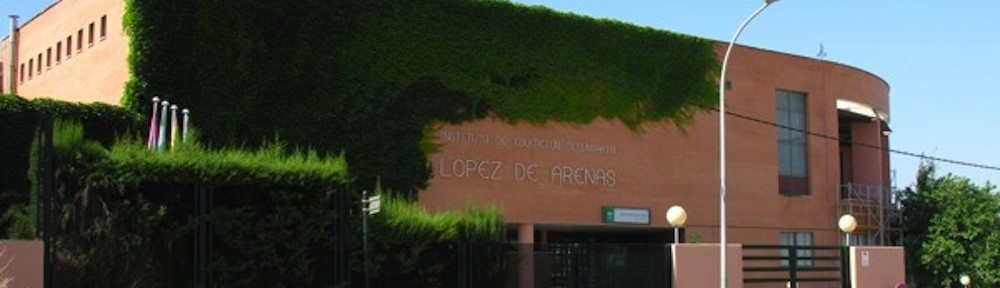


Participación en Emprendejoven
EL IES LÓPEZ DE ARENAS ESTARÁ PRESENTE EN XIII EDICIÓN DE EMPRENDEJOVEN CON CUATRO PROYECTOS DE EMPRESAS
El CONCURSO EMPRENDEJOVEN es un programa promovido por Andalucía Emprende, Fundación Pública Andaluza en colaboración con la Consejería de Educación, que tiene por objeto a los mejores Proyectos Empresariales elaborados por estudiantes ,que se encuentre cursando ciclos superiores o medios de la Formación Profesional.
El XIII edición de EMPRENDEJOVEN el IES López de Arenas estará presente con cuatro proyectos de empresas:
–Isywear S.L.: Cuya actividad empresarial trata de la comercialización de todo tipo de prendas adaptadas para enfermos crónicos y personas con movilidad reducida.
https://isywearsl.pswebshop.com
–Guardingkey S.L.: Sistema de consigna de llaves
https://guardingkeys.wordpress.com
–Comfortrent S.L.: Esta empresa se dedica alquiler al público de elementos difíciles de transportar en viajes, ya sea por espacio del maletero o por otros inconvenientes, como el peso al viajar en un avión o el espacio en un tren. Así como personas mayores o niños con discapacidad que necesitan algunos puntos de apoyo como, andadores, sillas de ruedas…
https://comfortrent.wordpress.com/
–Virtual Shop S.L.: Esta empresa se dedica a la venta de prendas a través de Internet
Primeras pruebas de Arenas FM
En la mañana de este jueves 12 de mayo, hemos realizado las primeras pruebas de nuestra emisora de radio escolar Arenas FM.
Se han realizado las primeras grabaciones con nuestros alumnos desde el área de grabación («Pecera»), así como desde el área de control.
Han participado en estas primeras pruebas alumnos de 3º de ESO y de 1º Bachillerato.


Languages are Alive!!! by Jessie
The cool thing about languages is that they are always changing—obviously the English that Shakespeare spoke is not the same as the English we speak today! Every year we find new words in the English language, and many of them become popular with people your age and my age. Here are some expressions you might hear (some common ones and some that are “new”) and that you might like to use yourself.
Have a one-track mind: when you only think about one thing
Example: “Thomas only thinks about football, he has a one-track mind.»
Walk the walk: to act according to the words you say (some people say a lot but do not act the same way!)
Example: “Carly says that she really wants to go to university, but she never studies. She needs to walk the walk.»
A piece of cake: something that is really easy
Example: “That English exam was a piece of cake, I got a 10!»
FOMO: “Fear Of Missing Out”—when you go somewhere because you don’t want to miss anything fun.
Example: “It was so rainy this weekend and I wanted to stay home, but then my friends invited me to a party. I had FOMO so I ended up going.»

basic: someone who is very boring/plain/does everything that is popular at the moment that everyone else is doing it
Example: “Allyson is wearing her white Converse sneakers with jeans and a short shirt. She’s so basic.»
YOLO: “You Only Live Once”—an expression used to motivate us to do something, because life is short
Example: “I was super nervous to go skydiving, but hey—YOLO!»
babe: a name for a really attractive person, also a name we use for boyfriends/girlfriends
Example: “The actor from The Hunger Games is such a babe, I love him.»
busted: when you get in trouble
Example: “Stephanie had a party in her house when her parents were gone, but they came home early and were so mad. She was busted.»
geek: a name for someone who is a little strange and likes things that are less popular (stereotypically they do not have a lot of friends, do not dress well, and are very intelligent—look for Steve Urkel on Google and he is the perfect example!)
Example: “That kid over there with the huge glasses and white socks is always on the computer alone. He’s kind of a geek.”
Hope to hear some of these in class with me this week and next! 🙂
Orientación Académica
Se acerca el final de curso y nuestros alumnos de 4º de ESO tendrán de adoptar una importante decisión para su futuro académico.
Durante la mañana del martes 10 de mayo se ha impartido una charla de orientación para los grupos de 4º ESO A y B a cargo de D. Luis Hinchado, perteneciente al Departamento de Orientación de EUSA (Centro Universitario adscrito a la Universidad de Sevilla, se encuentra integrado dentro en el Campus de la Cámara de Comercio de Sevilla).
En EUSA se pueden cursar los siguientes Grados Universitarios Oficiales:
- Doble Grado en Periodismo y Comunicación Audiovisual
- Grado en Comunicación Audiovisual
- Grado en Periodismo
- Grado en Publicidad y Relaciones Públicas
- Grado en Turismo
- Pasarela Grado en Turismo


Do dogs say «GUAU» in English?
ANIMAL ONOMATOPOEIAS
A funny question that I have sometimes heard from the youngest students is «Do dogs say ‘Guau’ in English?», or «How do dogs bark in English?». It may sound naive or childish but it is not so stupid to make that question as most people think.
To begin with let me show you this illustration that provides the onomatopoeia used in many languages of the sound dogs make. This will show you that we are dealing with a cultural aspect radically different from one language to another.

It is funny to notice the amount of onomatopoeias that there are in English. There are lots of words that imitate sounds and whose meanings are related to the sounds they evoke. Crash, crack, splash, zip, twank, boo, flip, knock, hiss, jingle, twinkle, boom, … and many more, are good examples.
When it comes to animal sounds, and in spite of a few similarities, it is funny to notice how different animals sound in English, that is, how different the word used to reproduce the sound of an animal in English is from the one used in Spanish. This is a very interesting cultural aspect.
If a cow says «moo» in English, what does she say in Spanish? Mu, of course. But when we’re talking about sounds that animals make, it isn’t always that simple.
That shouldn’t be surprising — after all, in English words such as «bark,» «bow-wow,» «ruff-ruff» and «arf» are used to imitate the sound of a dog.
The following list shows the sounds made by various «Spanish-speaking» animals and the equivalent word or sound used by the «English-speaking» animals.
- abeja(bee):bzzz (zumbar)— buzz
- búho(owl):uu uu (ulular)— who, hoo, hoot
- burro(donkey):iii-aah (rebuznar)— heehaw
- caballo(horse):jiiiiiii, iiiiou (relinchar)— neigh, n-a-a-a-y
- cabra(goat):bee bee (balar)—baa, b-a-a-a-a
- cerdo(pig):oink-oink, oinc-oinc (gruñir)— oink
- gallina(hen):coc co co coc (cacarear), kara-kara-kara-kara— cluck
- gallo(rooster):kikirikí, ki-kiri-ki (cantar)— cock-a-doodle-doo
- gato(cat):miau (maullar)— meow
- león(lion):grrrr, grgrgr (rugir)— roar, growl
- oveja(sheep):bee, mee (balar)— baa, b-a-a-a-h
- paloma(dove):cu-curru-cu-cú (arrullar))— coo
- pato(duck):cuac cuac— quack
- pavo(turkey):gluglú— gobble
- perro(dog):guau guau, guau (ladrar)— bark, bow-wow, arf, ruff
- pollito(chick):pío pío— chirp, tweet (That’s why Tweety is Piolín in Spanish)
- rana(frog):cruá cruá, berp, croac (croar)— ribbit, croak
- vaca(cow):mu, muuu (mugir)— moo

Exposición del Aula de Plástica
Los alumnos de ESO del Aula de Plástica han realizado dentro de la I Semana de las Artes y las Humanidades una exposición de los trabajos que esta´n desarrollando en la asignatura de Educación Plástica y Visual.


SOLIDARIDAD con Mayúsculas
Penúltima jornada de la I Semana de las Artes y las Humanidades en nuestro instituto. Manuel Blanco, bombero de la Diputación de Sevilla, y voluntario en la isla de Lesbos ofreciendo ayuda a los refugiados sirios, ha ofrecido una charla a más de doscientos alumnos del instituto desde 3º de ESO hasta 2º de bachiller.
Manuel Blanco, con sus palabras y sus imágenes nos ha abierto los ojos a la dura realidad que padecen los niños y adultos que llegan a Europa desde Siria huyendo de la guerra en busca un hogar seguro.


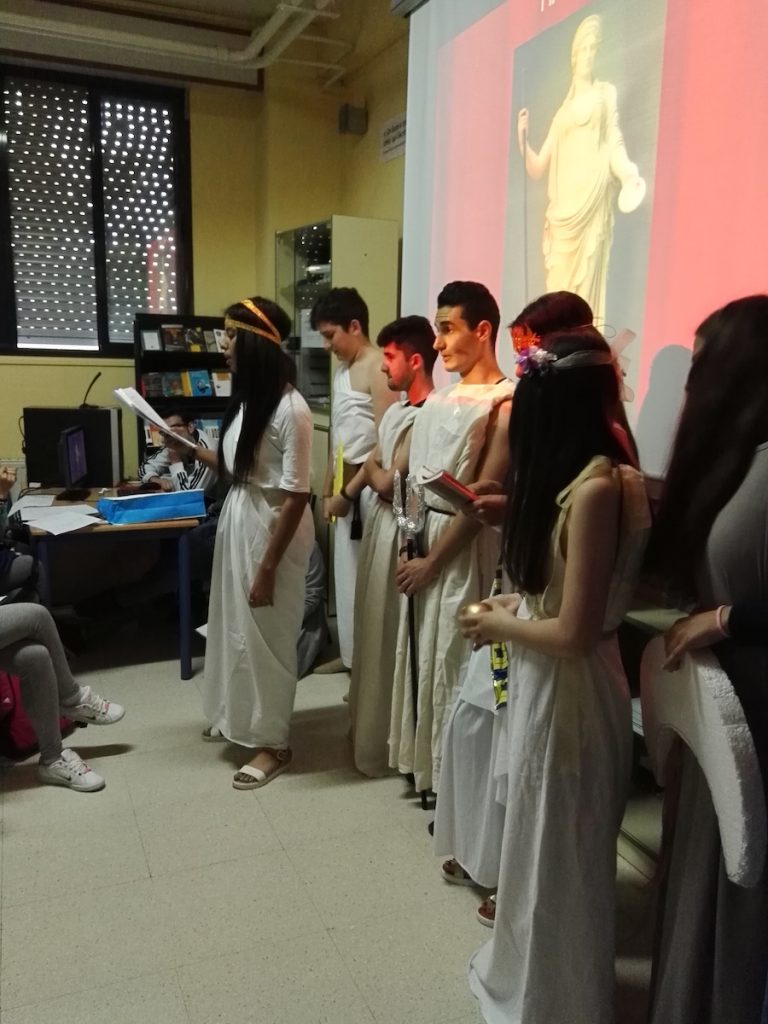
Dioses Griegos
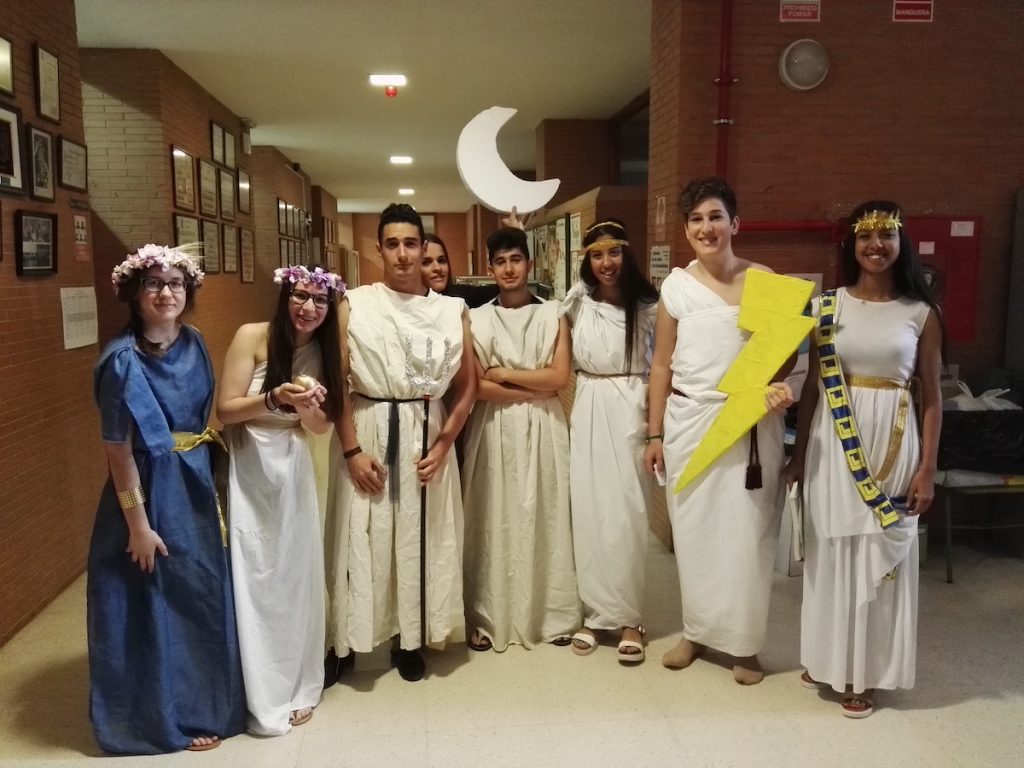
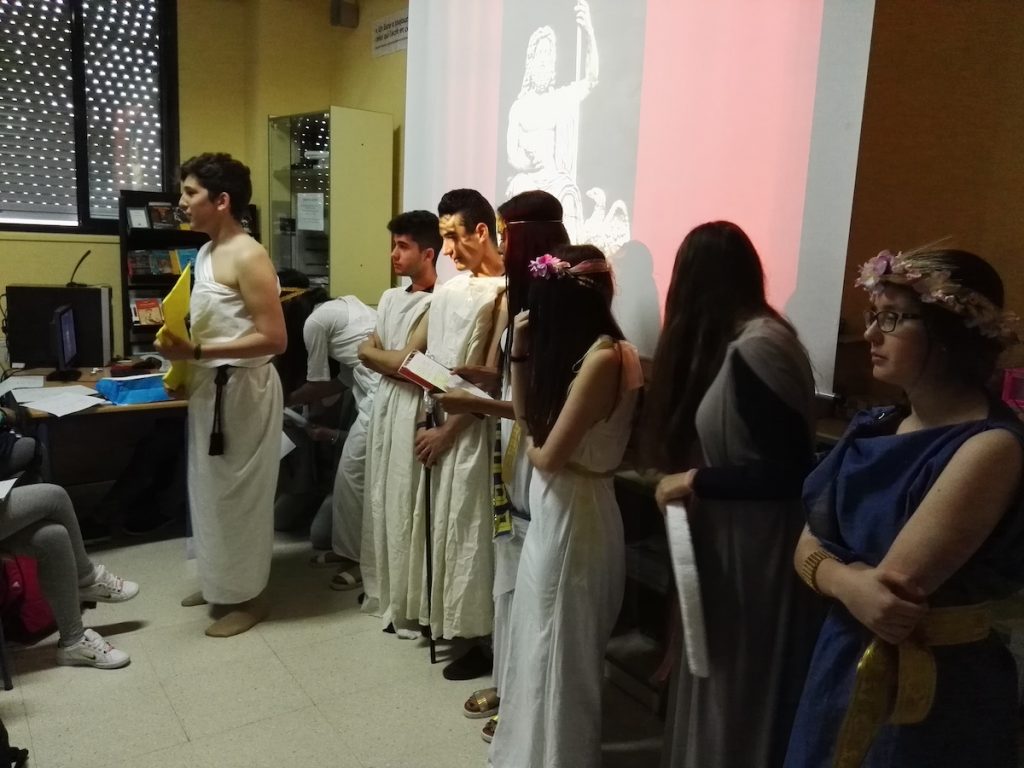
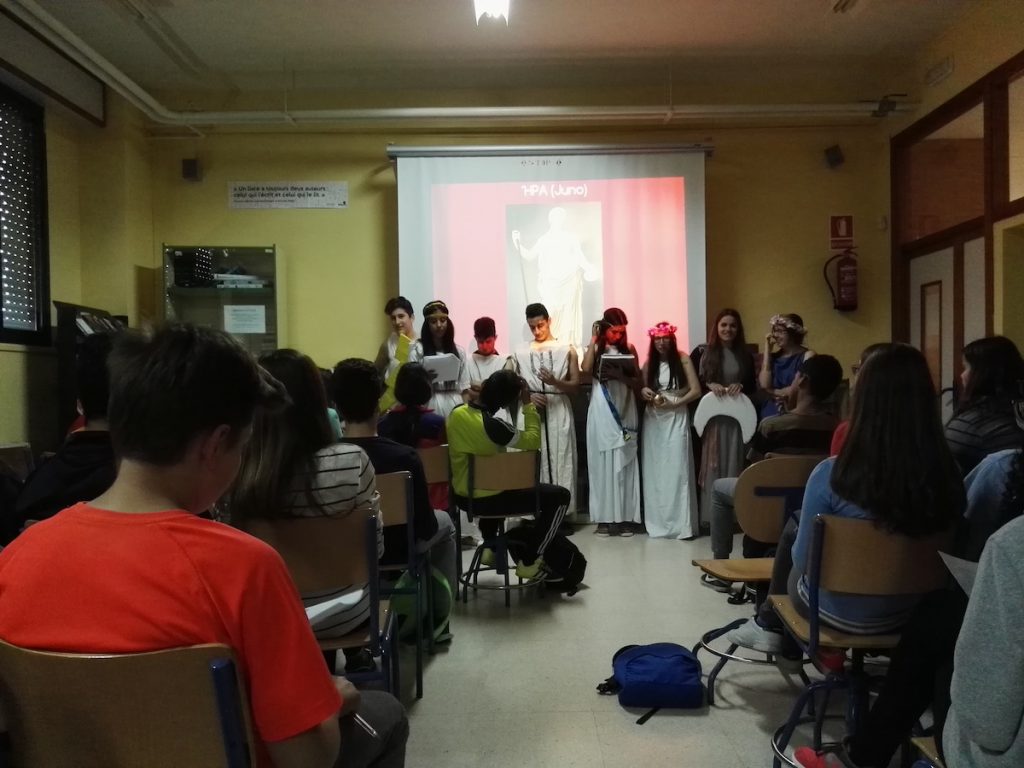
A lo largo del viernes 29 de abril y dentro de las actividades enmarcadas en la I Semana de las Artes y las Humanidades, los alumnos de 1º Bachillerato de Humanidades han escenificado a personajes de la Mitología Griega.
Los alumnos de Bachillerato le han explicado a los alumnos de la ESO, las principales figuras, el significado, funciones e historia de cada uno de los dioses.
Patrimonio Cultural de Marchena
Durante el jueves 28 de abril, los alumnos del I.E.S. López de Arenas han podido disfrutar de las conferencias impartidas por D. José María Díaz Luque, Licenciado en Historia y Vicepresidente de ACUPAMAR (Asociación Cultural para la Defensa del Patrimonio de Marchena).
Los alumnos han conocido una buena parte de los edificios que en nuestro pueblo tienen un alto valor arquitectónico, cultural y patrimonial.


dav